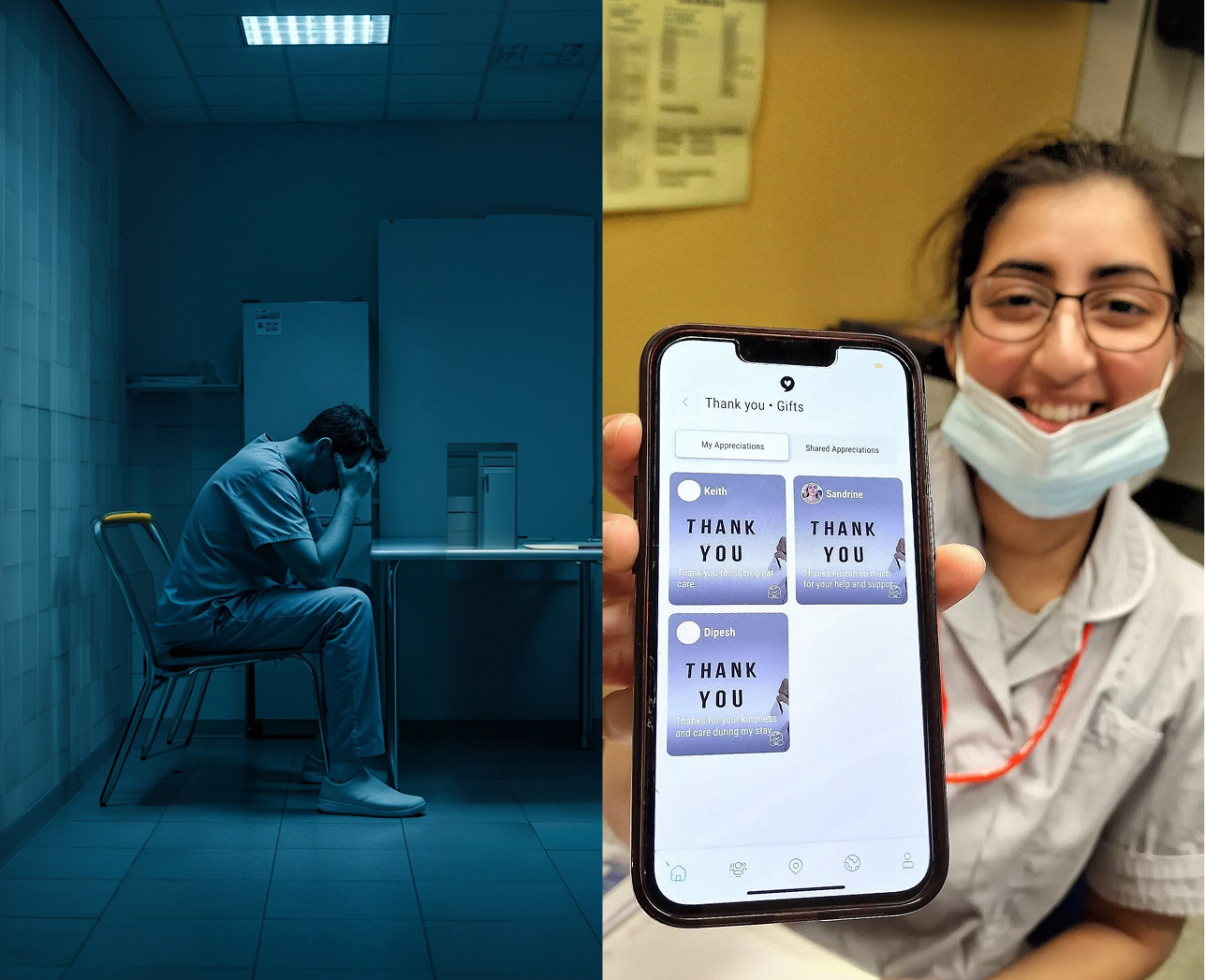
When healthcare staff experience Burnout, Patient Care and Hospital Finances suffer.
Healthcare staff are deeply committed people who chose this vocation because they care.
The pandemic reminded us how much we rely on them — and how fragile the system becomes when they are stretched beyond capacity.
Today, too many are exhausted, leaving the profession, or feeling invisible under mounting workload and cost-of-living pressures.

Whatever is highlighted... shapes Behaviour.
Complaints, media scrutiny, and negative reviews dominate public and organisational attention. While learning from failure is essential, this imbalance has unintended consequences.
For every complaint, there are countless moments of excellent care — moments that mean everything to patients and families, but are rarely captured or shared.
“When positive effort goes unseen, staff can feel their work makes little difference. Over time, this erodes morale, discretionary effort, and psychological safety.”
“The significant majority of patient encounters are positive and patients are grateful for the care they receive but we don’t focus on capturing and sharing that gratitude and positivity with our health care professional teams” – Richard Jenkins, Chief Medical Officer, PwC
Burnout impacts Engagement.
Healthcare organisations have invested heavily in wellbeing initiatives and engagement programmes.
Any solution that requires active participation is inherently limited in the environments that already need support.
This creates a paradox:
As burnout increases, staff are at their least able to engage — and the initiatives that depend on engagement become least effective, with staff experiencing all three dimensions of burnout (exhaustion, cynicism, reduced efficacy).
The most powerful recognition already exists — but goes unused.
Patients and their families want a simple, convenient way to express appreciation. The relationship between staff morale and patient care is deeply symbiotic.
Research consistently shows that praise and social approval are critical drivers of motivation, purpose, and resilience in healthcare work.
Yet healthcare systems have lacked a practical way to harness this goodwill and deliver it back to staff — in real time, across all roles, without adding burden.
Praise and social approval have proven to be critical factors in staff motivation and purpose. BIMPONG et al 2019
There is no recognition more powerful than that of patients.
HUMAN by ShareGratitude unlocks an untapped source of motivation and meaning at scale: this source of appreciation does not need to be grand—it just needs to be REAL.
Not through incentives or performance tracking — but through human connections.
It transforms this existing goodwill into a consistent, system-wide driver of burnout prevention, psychological safety, retention, and care quality.
What's been missing is a simple everyday way to make appreciation real for staff.
How it Works...